LANARS
Firmware and software
- Firmware for the floating unit
- Embedded vision stack
- Annotation platform (web app + APIs)
- Cloud data path
- Operator-facing tooling
- OTA pipeline

Case study · LANARS × SelectAI
LANARS built the firmware and the software for SelectAI's in-cage CV unit, in partnership with AI Experts. Live pilots on Norwegian salmon farms today; backed by Innovation Norway; targeting regulator-grade automated lice counting by end-2026.
At a glance
Context
Sea lice cost Norwegian salmon farming billions every year. A single adult female louse can produce up to fifty offspring per day in summer, and the manual standard — netting and counting fifteen to twenty fish per cage every week — samples too few fish to catch outbreaks before they bloom.
Weekly reporting to Mattilsynet is statutory. The Norwegian Directorate of Fisheries has publicly stated that count accuracy across the industry is too low and that tougher requirements are coming.
The opportunity wasn't another dashboard. It was a measurement tool precise enough to act as the regulator-grade baseline.
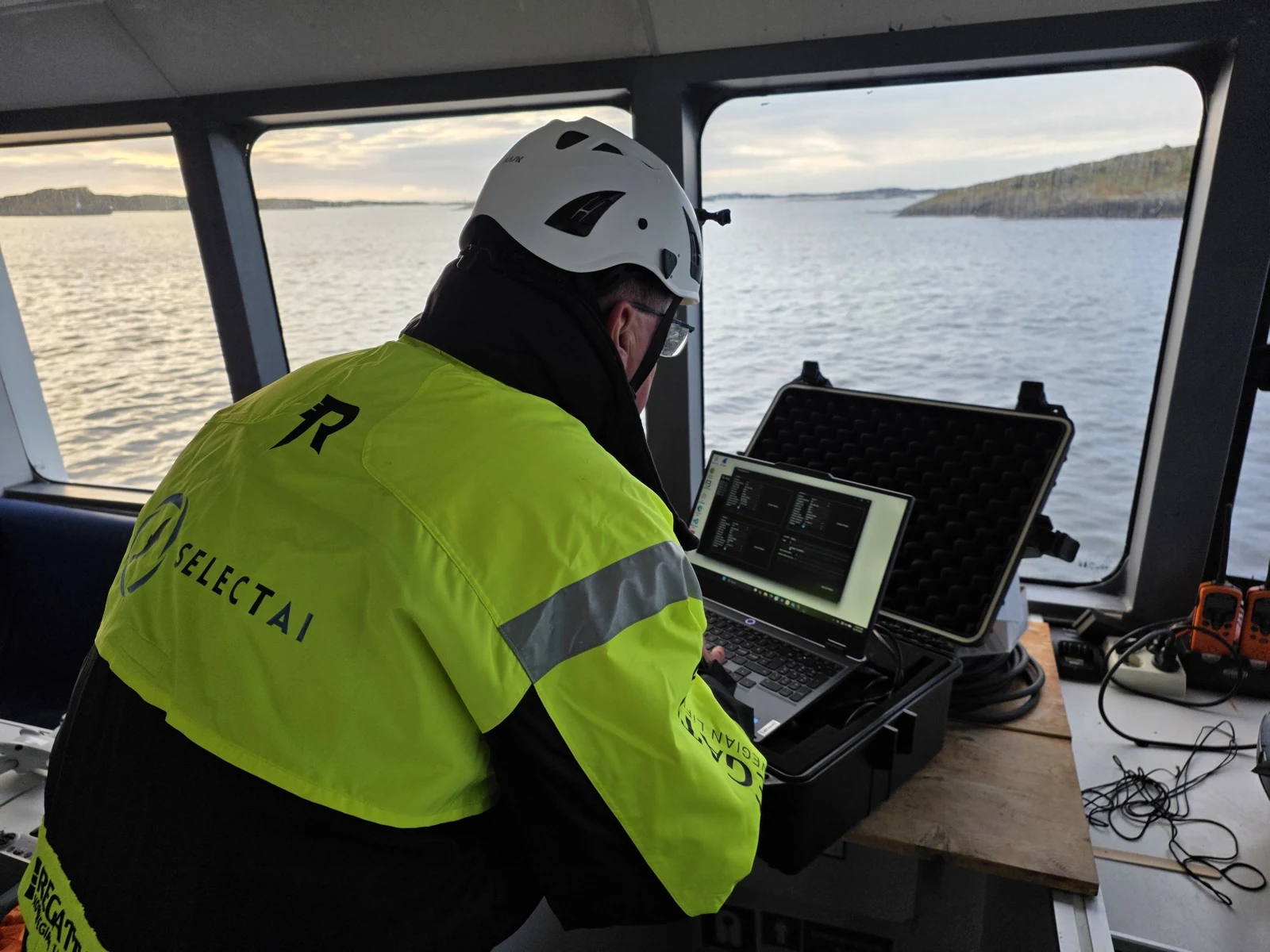
Three teams, one stack
LANARS
Firmware and software
AI Experts
Models and validation
SelectAI in-house
Product and operations
How it works
Patent-pending net guidance feeds salmon into a lit analysis channel one at a time. Three synchronised cameras image left, right and underside in a single capture. The annotation pipeline maps detections directly to the five Mattilsynet lice classes and the Laksevel welfare scale — no internal mapping layer.
Guided channel
Patent-pending net system; fish swim through voluntarily, no anaesthesia, no manual handling
Tri-camera capture
Three synchronised lenses, multispectral lighting, motion-triggered frames
Vision engine
On-device pre-processing, cloud-side inference, biologist-reviewed annotation loop
Mattilsynet-ready report
Weekly lice-per-fish, Laksevel welfare summary, image-traceable assessments
Inside the unit
One fish, three angles, logged once. Single-angle competitors double-count.
Three lenses fire in the same frame window
Standardised illumination plus cameras registering up to 60% more colour shades than the human eye.
Picks up signals an inspector would miss
Compute and storage are spent only on frames with a fish in them.
No background imagery in the pipeline
No power or internet on the cage. The unit runs off-grid and syncs on retrieval.
Built for tough maritime conditions
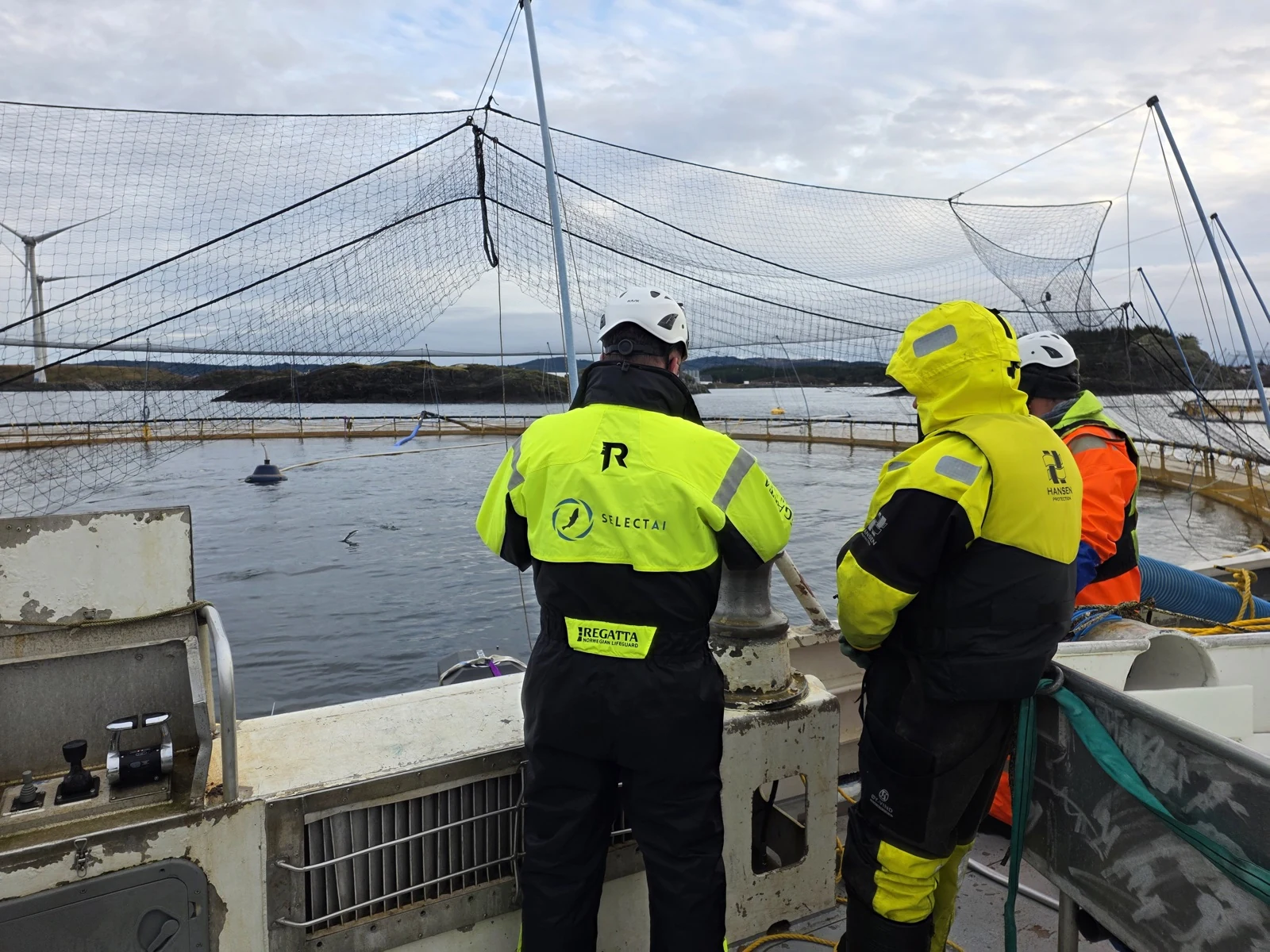
Tested through a Karmøy winter. No drama on the hardware side.
Validated on Varde Fiskeoppdrett, December 2025
Disease detection, biomass, respiration, other species — roadmap features ship as software updates to the same unit family.
Same hardware, new abilities
The foundation
Artificial intelligence is only as good as the data it learns from. When training a model to detect sea lice or welfare injuries, the process relies entirely on labelled images — photographs where a human expert has already identified and marked what the AI is expected to learn to recognise. If those images are blurry, poorly lit, or only show one side of the fish, the labels are uncertain at best and wrong at worst.
Before asking what an AI can detect, ask a simpler question: can a trained expert clearly see and identify the lice or the injury in this image? If the answer is no, the AI has nothing reliable to learn from — and nothing reliable to deliver. This is why image acquisition matters as much as the algorithm itself.
SelectAI Focus is built around this principle. As each fish passes through the channel, three synchronised cameras capture the entire surface under standardised lighting — dorsal, ventral and lateral, every fish, every pass. The results are based on full statistical coverage of the population, not on predictions extrapolated from a partial view. For sea lice counting and welfare assessment, that's the difference between knowing and estimating.
Consistent, high-quality images collected under identical conditions over time do more than support today's reporting requirements. They build a growing, labelled dataset that makes new models possible — early disease detection, biomass estimation, respiration monitoring. The value of an aquaculture AI platform is not only what it does today; it's the foundation it builds for tomorrow.
Annotation suite
The annotation tool is where biologists turn captured frames into labelled data. Every fish is reviewed across three synchronised camera angles, lice are categorised against Mattilsynet's clinical taxonomy, and welfare indicators are localised pixel by pixel — with timestamp, operator, GPS and source frame travelling with every record.
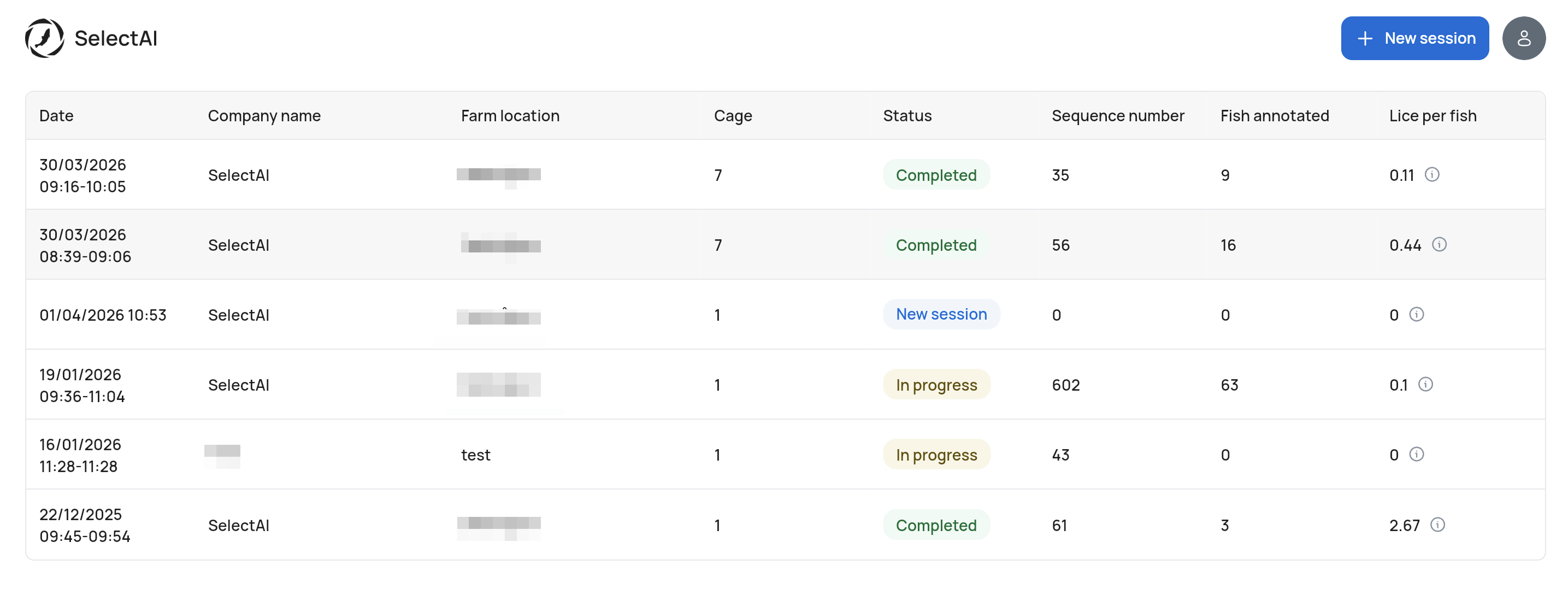
Tri-angle pane, one specimen
Left, right and underside annotated together so the same fish is never double-counted.
Clinical lice taxonomy
Stuck · Movable · Mature female · Skottelus · Free-swimming. No internal mapping layer.
Welfare-indicator boxes
Wounds, fin damage and scale loss localised pixel-accurate for downstream training.
Audit-grade reports
Every annotation carries timestamp, operator, GPS and source frame.
Measured, not promised
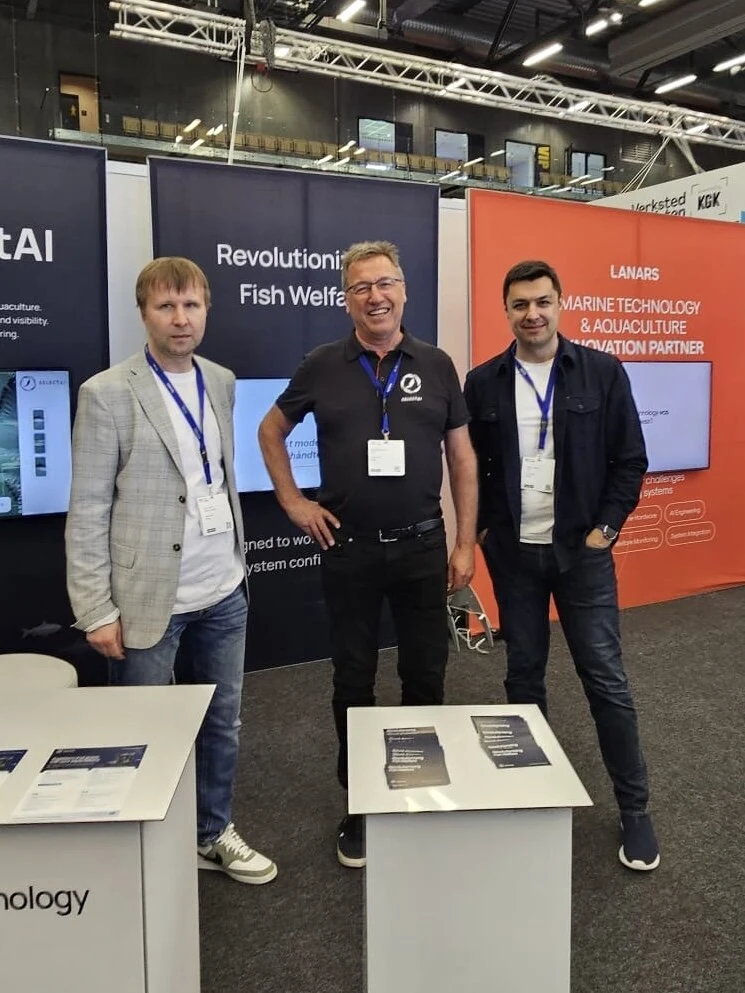
From the founder
"The aquaculture industry faces some of the toughest ecological challenges of our time — yet most farms still rely on tools and methods that haven't meaningfully changed in over a decade. We're not here to sell another promise of a digital future. We're here to deliver a real result today: help the farmer act before an outbreak, lift fish welfare in measurable ways, and do it at a price that actually makes sense for the industry."
Tech stack
We do firmware, embedded vision, AI integrations and the platforms that make them usable. Tell us what you're building and we'll come back within a business day.



